
How to Check Criminal History in Chattooga County
A sound Chattooga County criminal record search begins with the question the record must answer. Current custody belongs with the county jail. An arrest narrative belongs with the agency whose officer wrote it. Filed charges and final judgment belong with the proper court clerk. A statewide felony-conviction result comes from the Georgia Bureau of Investigation's Georgia Felon Search. These sources overlap, but none replaces all the others.
Gather the full name, date of birth when lawfully available, event date, city or location, and any incident, booking, warrant, OTN, citation, or case number. Spelling variants matter. So does court level. Chattooga Superior Court hears felonies, State Court handles misdemeanors and traffic within its authority, and Magistrate Court deals with warrants and early hearings. Municipal matters remain with the city court.
- Identify whether the event is an incident, booking, court case, conviction history, custody record, warrant, or registry entry.
- Contact the office that created that record and provide a narrow date range plus known identifiers.
- Compare the result with the next stage, such as a jail booking against the later court docket.
- Ask the clerk or records officer about redactions, missing older files, and plain versus certified copies.
- Use a fingerprint-supported official check when identity must be resolved more reliably than a name match.
Note: A no-result from one Chattooga County source does not prove that no record exists in another office or court.
Chattooga County Record Custodians
Chattooga County has no single public counter for every criminal record. The most direct route is to follow the document back to its creator. This avoids asking a prosecutor for a clerk file or asking the jail for an officer's narrative. It also helps when the same event has different identifiers at each stage.
| Record sought | First official channel | Useful fallback |
|---|---|---|
| Incident or arrest report | Arresting sheriff, police department, or Georgia State Patrol | Georgia Open Records Act request to that agency |
| Booking or current custody | Chattooga County Jail | Georgia VINE or GDC after transfer |
| Filed charge or disposition | Clerk for the court that heard the case | PeachCourt for participating Superior and State Court access |
| Georgia felony-conviction history | Georgia Felon Search | Local law-enforcement history procedure or fingerprint channel |
| Active or case-linked warrant | Sheriff and issuing court | Magistrate or municipal clerk, based on origin |
The Georgia E-Access directory routes users to participating court systems. It is not a complete statewide trial-court database. For Chattooga Superior and State Court, Georgia Courts points to PeachCourt, where an account is required for search access.
Official Georgia Background Checks
The Georgia Bureau of Investigation, through the Georgia Crime Information Center, maintains the central criminal-history repository. The public Georgia Felon Search answers a narrow question: whether supplied identifiers produce an in-state felony-conviction match available under Georgia law. It costs $15 per transaction even when no record is found. Multiple possible matches can require an added $15 transaction for each record opened.
A name result is not conclusive identity proof. The search uses full name, race, sex, and date of birth, and it excludes misdemeanors, restricted or sealed data, and qualifying juvenile information. Fingerprints are the more reliable identity method. The Georgia Applicant Processing Service through IDEMIA/IdentoGO requires an authorized service code for agency-directed checks. GCIC says those agency results normally become available within 24 to 48 hours after prints are submitted.
| Official product | Method | Known charge |
|---|---|---|
| Georgia Felon Search | Name and required identifiers | $15 per transaction |
| GAPS/IdentoGO | Fingerprint capture with agency authorization | Shown during enrollment |
| FBI Identity History Summary | Personal fingerprint-supported national review | $18 base fee |
Chattooga County Felon Search Fields
Georgia Felon Search works best when the reader knows the exact identifiers used in the source record. A common name can return more than one possible candidate, while a misspelled name or wrong birth date can hide the likely match. The portal's result remains a possible name-based match, not a fingerprint identification.
| Field | Requirement | How it helps |
|---|---|---|
| Full name | Required search identifier | Use the legal spelling and check known variants |
| Date of birth | Required identifier | Separates people who share a name |
| Race | Required identifier | Supports the statutory matching process |
| Sex | Required identifier | Supports the statutory matching process |
| Payment | Required per transaction | The fee applies even to a no-record response |
When a Chattooga County event is absent or has no final outcome, obtain the certified disposition from the court and contact the submitting agency. GCIC cannot change source-agency data on its own. The correction path depends on proof from the office that created or resolved the record.
Types of Criminal Records
A Chattooga County criminal history is assembled from records made for different jobs. The officer documents what was reported and what led to an arrest. Jail staff create intake and release data. The court records what prosecutors filed and how the judge or jury resolved each charge. GCIC links fingerprint-supported arrest cycles to dispositions that agencies later submit.
- Incident and arrest reports: agency narratives, event facts, alleged offenses, and officer action, subject to lawful redaction.
- Booking records: intake time, agency, charge, warrant references, bond, custody, release, and facility data.
- Court case files: accusation or indictment, docket events, pleas, motions, disposition, judgment, and sentence.
- Warrant records: issuing court, case or warrant number, issue date, alleged offense, bond, and status when public.
- Custody and supervision records: GDC prison data, court-imposed probation, DCS supervision, and parole-board action.
Each source has a different time frame. Booking allegations may change before a case is filed. A later dismissal will appear in a court disposition, but an old agency report may still exist. The Chattooga County criminal court case file is the source for the filed charge and judgment.
Chattooga County Jail Record Chain
The official county pages did not expose a clearly working public jail roster during research. That absence makes phone, counter, and records-request channels central for Chattooga County. Call the direct jail line at 706-857-0721 for current custody or the sheriff's main line at 706-857-3411 for routing. A booking request can seek the booking number and time, arresting agency, intake charges, warrant or case references, bond, and release status.
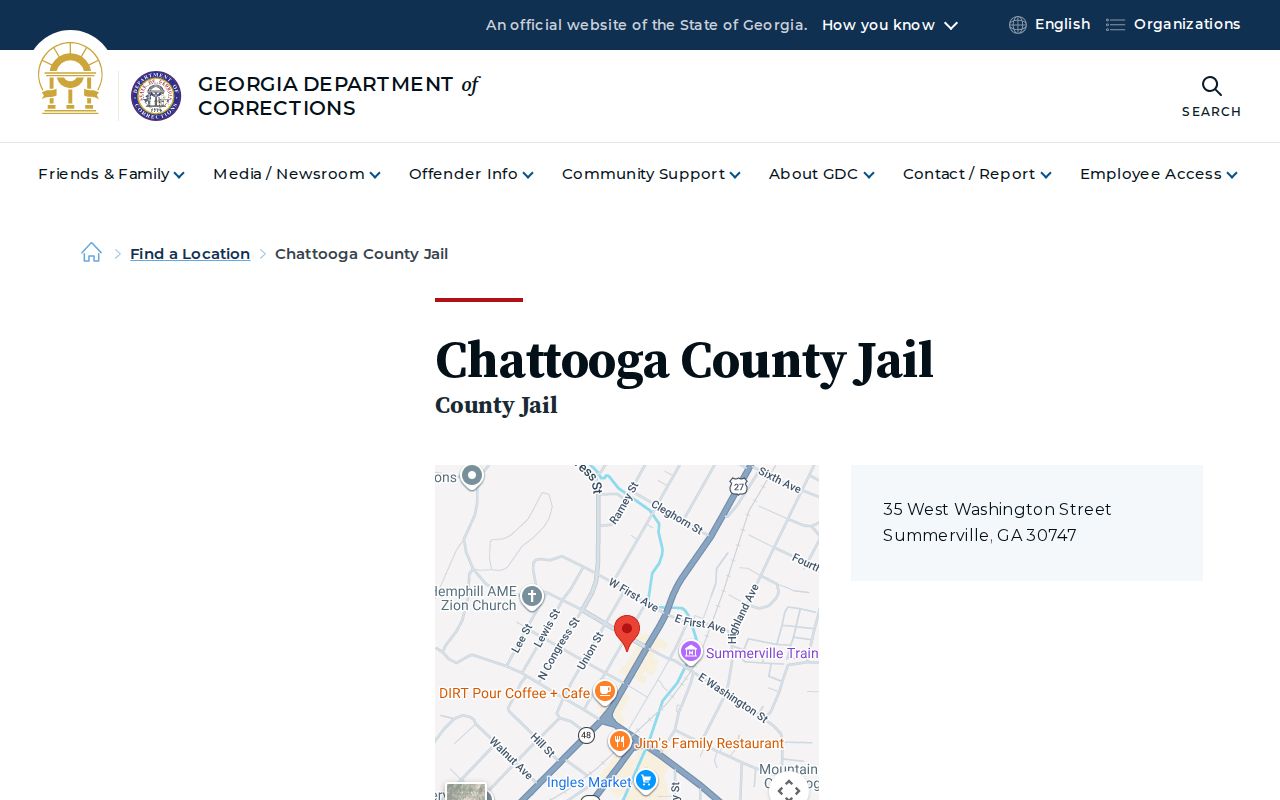
The Georgia Department of Corrections listing for Chattooga County Jail identifies 35 West Washington Street, Summerville, GA 30747. The official source image below preserves that state listing as inspected. It does not establish a roster, capacity, visitation vendor, or deposit rules.
Use GDC Find an Offender after transfer to state correctional custody, the federal BOP locator for federal custody, and Georgia VINE for participating custody-status notices. None reproduces the Chattooga County incident narrative. Booking status can also change fast when bond is posted, a hold is added, or a person transfers.
Note: Confirm the correct counter before travel because official records also reference a future sheriff location at 533 Underwood Drive in Trion.
What a Chattooga County Criminal Record Shows
The fields depend on the source. A GCIC history centers on identity, arrest cycles, submitted dispositions, and custodial data. A Chattooga County court file is organized by case number and docket. A jail entry is organized by booking event. Public versions omit or redact protected identifiers, victim data, juvenile material, sealed filings, and other exempt content.
| Name & Identifiers | Name, date of birth, physical descriptors, OTN or SID where lawfully shown; Social Security numbers are not expected in a public view. |
|---|---|
| Arrest / Booking Data | Arresting agency, date, intake charges, booking number, bond, custody, and release status. |
| Charges & Statutes | Alleged booking charges or prosecutor-filed counts with Georgia code references. |
| Disposition | Conviction, dismissal, acquittal, no bill, nolle prosequi, or another recorded outcome. |
| Sentence | Custody, probation, fine, restitution, or other terms contained in the judgment. |
| Custody / Supervision | Facility and sentence status from GDC, or public evidence that probation or parole was imposed. |
A charge is not the same as a conviction. Nor is a jail status the same as a sentence. Compare identifiers and dates, then read the final disposition for each count before drawing a conclusion about a Chattooga County case.
Chattooga County Record Terms
Short labels can change the meaning of a criminal record. These Georgia terms appear across Chattooga County arrest, court, and repository files. Reading them in context prevents a pending allegation from being mistaken for a final outcome.
- OTN
- The offense tracking number used to connect an arrest and its later disposition.
- Accusation
- A prosecutor-filed charging document often used for offenses that do not require indictment.
- No bill
- A grand jury's decision not to return an indictment.
- Nolle prosequi
- A prosecutor's formal choice not to pursue a charge at that time.
- Disposition
- The recorded outcome of an individual charge.
- Record restriction
- Georgia's process for limiting eligible GCIC data from ordinary public dissemination.
Public Access Laws
The Georgia Open Records Act favors access to public records, but it does not erase every exemption. Chattooga County offices may redact protected parts while releasing the rest. A precise request should name the record, agency, date range, location, incident or case number, desired electronic format, and a cost ceiling. The office generally has a three-business-day response framework, which may be a production response, estimate, or lawful explanation rather than the final file.
Key Georgia laws:
O.C.G.A. §50-18-70 states Georgia's policy in favor of public access.
O.C.G.A. §50-18-71 governs requests, timing, search and redaction labor, and copy charges.
O.C.G.A. §35-3-34(d.2) permits specified public felony-conviction searches with required identifiers.
O.C.G.A. §35-3-37 governs record restriction, correction, and related court sealing.
O.C.G.A. §42-1-12 governs registry duties and public dissemination.
Under §50-18-71, an office may charge for the lowest-paid qualified employee's search, retrieval, and redaction time after the first 15 minutes. Letter or legal paper copies are generally ten cents per page, with actual media costs allowed. Ask for native electronic files and an itemized estimate.
Chattooga County Sheriff Requests
The Chattooga County Sheriff's Office holds sheriff-created incident material, warrant information it can disclose, and county booking records. Its public records process requires enough detail to locate the file. Useful fields include the requester's contact information, event date and location, involved names, report or case number, the exact record sought, delivery method, and fee authorization.
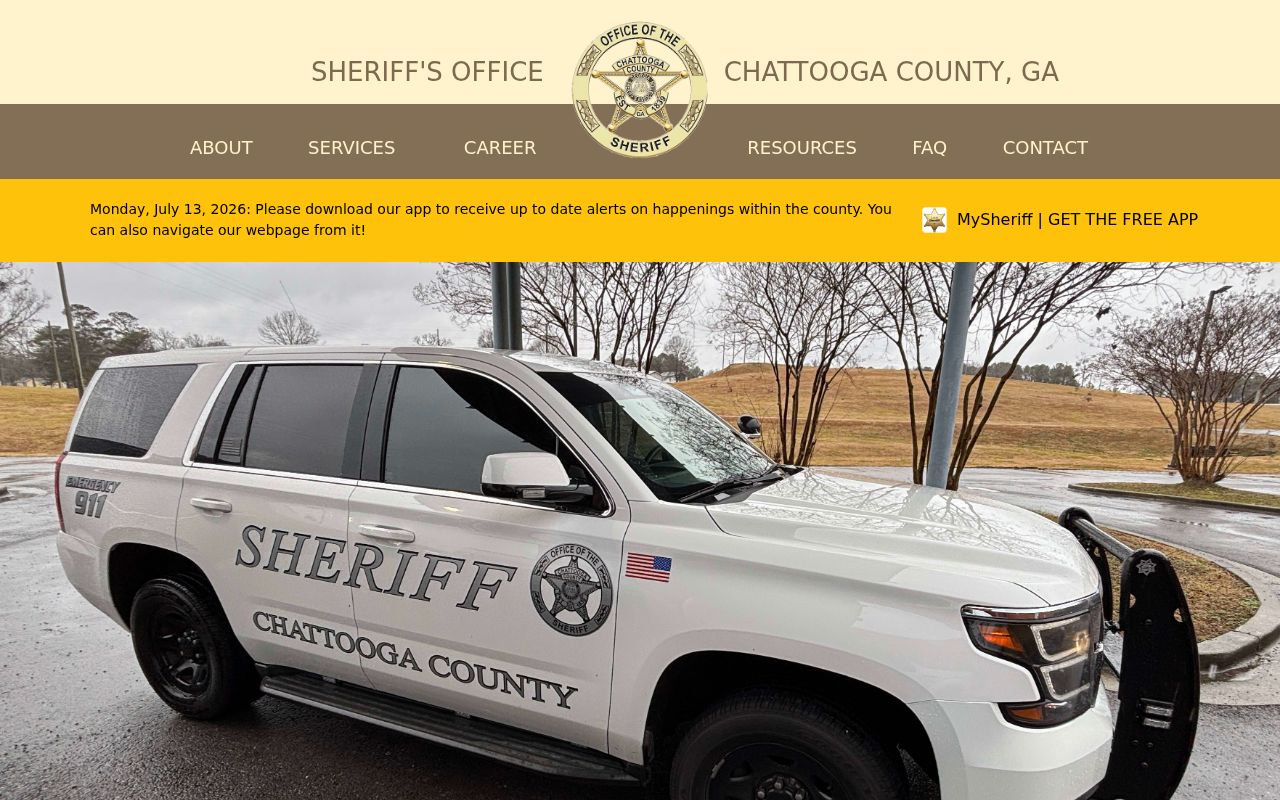
The official Chattooga County Sheriff's Office page is the source for the office channel shown below. The captured page documents the sheriff's official web presence rather than a third-party directory.
Submit a narrow request and ask for an estimate before broad retrieval work begins. An ongoing prosecution may still permit an initial incident report or arrest and booking report while body-camera video or investigative material is withheld or delayed. Redaction does not mean that every part of the Chattooga County record is closed.
Chattooga County Sheriff's Office
35 West Washington Street
Summerville, GA 30747
706-857-3411
Superior and State Court Clerk
10035 Commerce Street
Summerville, GA 30747
706-857-0706
Sealed, Expunged & Restricted
Georgia calls its main relief process record restriction, not expungement. Restriction can block eligible GCIC history from ordinary public and noncriminal-justice dissemination. It does not necessarily destroy the arresting agency's report or remove the public court file. Court sealing is a distinct step under O.C.G.A. §35-3-37(m) after eligible restriction and required judicial findings.
For an arrest on or after July 1, 2013, GBI directs the person to the prosecutor. For an older arrest, the Request to Restrict Arrest Record begins with the arresting agency, continues through prosecutor review, and then reaches GCIC with the required payment. An arresting agency or prosecutor may charge up to $50. GCIC generally processes a complete approved application in two to three weeks, and a prosecutor denial may be appealed to Superior Court within 30 days.
Start by obtaining one's GCIC history and certified final disposition. Identify the arrest date, OTN, agency, and every charge from that arrest. Then follow the correct pre- or post-2013 path, keep the written decision, and address the Chattooga County court file separately. Dismissals, acquittals, no bills, and some non-prosecuted charges may qualify, but pending charges, convictions, and statutory exceptions need careful review.
Chattooga County Warrant Layers
No verified public countywide active-warrant database was found for Chattooga County. That does not mean warrant information is unavailable. It means the search must follow the issuing and holding offices. The sheriff can address held or executed warrant information it may release, and Magistrate Court at 706-857-0711 handles many warrant proceedings.
A bench warrant or failure-to-appear order may instead arise in Superior, State, Probate, or a municipal court. Use the case number or citation to contact that clerk. A public record may show the name, issuing court, warrant number, issue date, alleged offense, bond, and current status. Sealed warrants and juvenile matters are not public.
Do not treat absence from PeachCourt or the sheriff's advertised MySheriff app as proof that no warrant exists. The app is verified as free and requiring no registration, but its exact menu features were not confirmed. Anyone addressing a possible warrant should ask the issuing court or counsel about the correct appearance and bond process instead of arriving based only on web data.
Criminal Records by City in Chattooga County
City police and municipal courts add their own layers to Chattooga County criminal records. Summerville Police keeps its reports while the city court hears traffic, ordinance, and parking matters. Trion Police retains town-created reports even when booking occurs at the county jail. Menlo searches often begin by confirming whether the sheriff, Georgia State Patrol, or a municipal channel handled the event. The 2024 Census estimates rank Summerville, Trion, and Menlo as the county's three largest incorporated places.
Summerville Criminal History
Population 4,421 · Police reports and Municipal Court records begin with the city.
Trion Criminal History
Population 1,972 · Town police records stay separate from county booking files.
Menlo Criminal History
Population 484 · Confirm the responding agency before sending a request.
Chattooga County Supervision Records
A sentence entry may state that probation was imposed, but an old docket does not prove that supervision remains active. The Georgia Department of Community Supervision manages adult felony probation and parole field supervision. The Georgia State Board of Pardons and Paroles handles parole decisions. Misdemeanor probation may be local or run through a court-approved provider.
Use the Chattooga County judgment for the sentence, GDC Find an Offender for state custody and sentence data, the DCS office locator for current official routing, and the parole board for its public decision tools. Officer notes, risk assessments, detailed conditions, and pending violation work should not be assumed public.
A probation violation can lead to a warrant, petition, hearing, and court decision. Those steps may appear in different systems at different times. Verify current status with the office that now holds the record instead of inferring it from the length of the original Chattooga County sentence.